Showing posts with label Rests. Show all posts

Friday, October 20, 2006

Day Ten - Types of Notes, Rests and Dynamics

Still away from my beautiful new instrument, I decided that it was time again to pursue with the learning of the language otherwise known as Music. Again, I turned to my trusty companion, T'Internet. Lo and behold, I also used my fancy graphics software to help to depict what I was learning.


While there are more than the above, this will suffice for now I think. We start from the left, where we can see a single note (A Semi-Breve) on it's lonesome filling up the whole 4/4 measure. In the next, we have two half-notes (Minims) that make up a full bar. Then we have four Quarter-Notes (Crotchetts), eight Eigth-Notes (Quavers) and finally a bar of Sixteenth Notes (Semi-Quavers). Essentially, we're breaking up the bar (of a fixed length) into a number of parts, each of which we fill with a note. Which leads onto the question - what happens if you don't want a note (and want some quiet from the awful racket that your violin is currently making)?

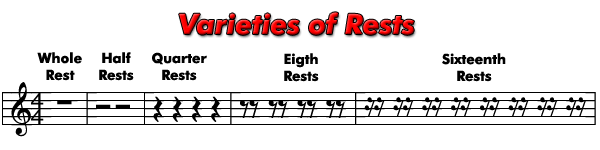
Thus, the lord brings us Rests. Luckily, these come in the same flavours as the above, giving us essentially 'silent notes' as depicted in the following diagram;

Last but not least for this lesson, something simple to finish on. It also seems that they sometimes stick letters on the staff to ask you alter the volume (and they also tend to call this Dynamics, luckily, not of the applied mathematics type...) They are as follows;

ppp???Very, Very Quiet
pppianissimoVery Quiet
ppianoQuiet
mpmezzo-pianoSlightly Quiet
mfmezzo-forteMedium Loud
fforteLoud / Strong
fffortissimoVery Loud
fff???Extremely Loud
crescCrescendoGradually Get Louder
decrescDecrescendo / DiminuendoGradually Get Quieter


That concludes todays lesson to myself. Don't hesitate to come back tomorrow for the rest of Reading Music 101.

Thursday, October 19, 2006

Day Nine - Clefs, Time Signatures & Waits

Today I decided to actually absorb some knowledge about the alphabet of Music. With help of the internet and some friends, I thought I would start from scratch. Although I already know a bit about the clefs etc, I thought I would lose Face quicker than the A-Team in a Maze if I didn't know all the basics. (Joke shamelessly stolen from Not Going Out because it was that good).

And so, I crafted the following diagram with my own bloody hands to describe the very basics of Music.


While we're only interested in the Treble Clef with the Violin, it's useful to just see how the two fit together. The Red "C" on both staffs depict the same note, the middle C. The letters in Blue are the letters in between the lines. I remember the Treble clef simply by thinking "FACE", but the Bass clef is a little less obvious, so I learnt the Mnenomic "All Cows Eat Grass". As for the other marks on this diagram. The "Squiggle" is a quarter bar rest. As we have 4 notes per bar here, we need 3 to make the last bar "Valid".

Last but not least, we come to the 4/4 notation after the clef. This is the time signature of the piece which tells you how many notes to expect per measure and the length of each note. The top value is the number of notes per measure, while the bottom value tells you how long each of those notes is (as a fraction over one). For example, the standard time measure 4/4 shows 4 quarter (1/4) notes per measure. 3/4 shows 3 quarter (1/4) notes per measure. Finally, (6/2) for instance would be 6 half (1/2) notes per measure. Grooby baby.